By Santiago Fernández de Valderrama Aparicio, Applied AI Operator · Last updated
career-ops vs JobHire.AI
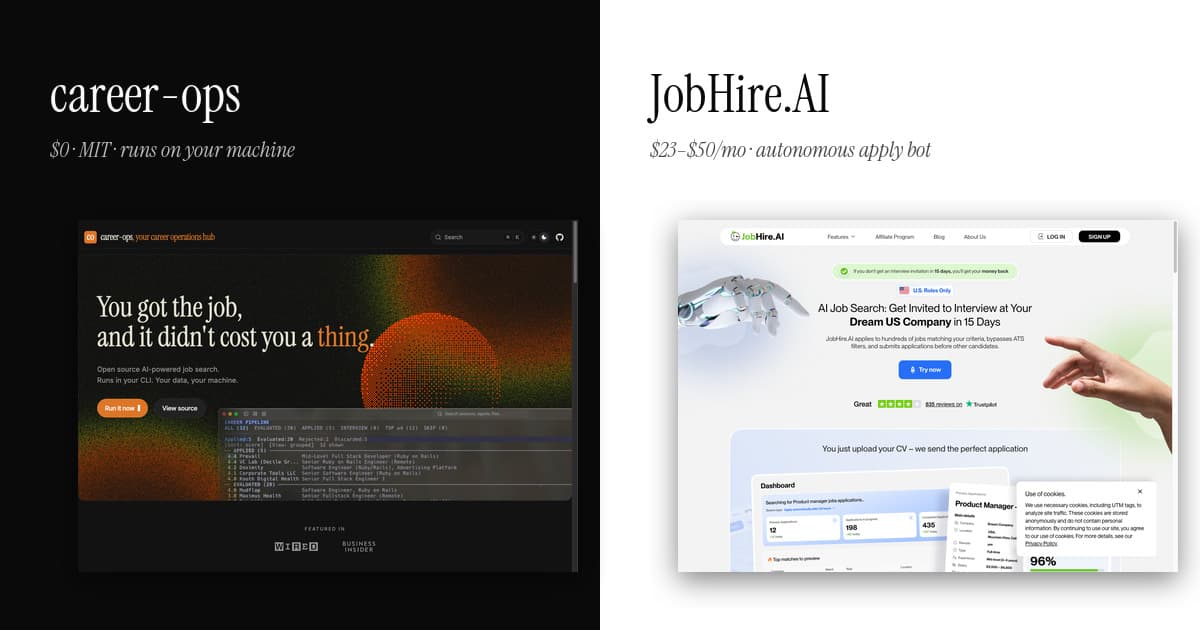
JobHire.AI is set-and-forget: an autonomous agent that tailors resumes and submits applications in the background. career-ops automates everything except the decision — free, MIT-licensed, running locally in your AI CLI, it scans, scores and prepares each application, then stops. If an agent applying without you feels wrong, that instinct is the comparison.
JobHire.AI is the autonomous-agent flavor of auto-apply — set rules, walk away, the bot resume-tailors and submits in the background. career-ops is the opposite stance: you stay in the loop, the system drafts everything you need to apply well, and you click submit. Different philosophies, very different ethical postures.
The honest summary
Pick career-ops if you want the system to draft everything but keep the submit decision yours. Pick JobHire.AI if you want to step away from the search and accept the trade-offs.
JobHire.AI sells convenience. Upload a resume, set parameters, walk away. The agent applies in the background while you do other things. For candidates who have decided the job search is not where they want to spend cognitive cycles, that pitch has real value.
The trade-offs match the auto-apply category broadly. Submission quality varies; user reports include applications going to roles outside the candidate's seniority band. The 'money-back guarantee' is contested in practice — Reddit threads document users struggling to actually claim refunds when promised interviews did not materialize. And the contribution to recruiter pipeline saturation is the same as any other auto-apply tool, which means response rates on JobHire-submitted applications skew lower than on tailored applications.
career-ops takes the opposite stance because the maintainer used it on his own search and concluded the leverage is in tailoring depth, not volume. Every application goes through the apply mode, which drafts contextual answers for every open-ended question. The candidate reviews and submits. That keeps the cognitive cost meaningful but capped (5 minutes per application instead of 25), and it keeps the response rate where it needs to be for an active search to actually convert. If you are willing to invest a few hours a week in a search that produces interviews, career-ops produces materially better outcomes. If you have decided you genuinely cannot, JobHire.AI is the trade-off you are choosing.
Feature matrix
| Feature | career-ops | JobHire.AI |
|---|---|---|
| Application model | Score-gated apply. You stay in the loop on every submission. | Autonomous agent. Set parameters, the bot submits applications automatically based on resume-JD matching. |
| Pre-apply form assistance | Yes — apply mode drafts contextual answers for every open-ended portal question from your profile + JD. The candidate reviews and pastes. | Auto-fills and submits forms without explicit candidate review per submission. Open-ended answers generated and submitted by the agent. |
| Candidate visibility | Every artifact is a local file you can read, edit, version-control. | Cloud dashboard. Visibility into what the agent submitted is post-hoc. |
| Refund policy | N/A — the software is free and MIT-licensed. | Marketed 'Money-Back Guarantee' if no interview in 15 days. Reddit threads document widespread refund-claim disputes. |
| Submission volume | Bounded by the rubric — typically 5-10 high-fit applications per day during active search. | High. The agent submits continuously based on configured parameters. |
| Recruiter pipeline impact | Filter-driven. Recruiters get fewer, better-matched applications. | Volume-driven. Same pipeline-degradation contribution as other auto-apply tools. |
| Tailoring depth | Tailor mode rewrites cv.md per listing through your AI CLI. Tailoring is auditable in the local file. | Resume optimization advertised per submission. Quality varies; user reports include submissions to roles outside the candidate's seniority band. |
| Data ownership | Local-first. Profile, applications, history on your machine. | Cloud-hosted. Profile and complete search history on JobHire servers. |
| User-reported reliability | Stable. Failures are visible because everything runs locally. | Mixed. Aggressive marketing claims ('land an interview 10x faster') are not consistently borne out in user-reported outcomes. |
| Recurring cost | $0 for the tool. Claude Pro $20/mo typical. | $23–$50/month depending on tier. |
| Source code | Open source, MIT-licensed. github.com/career-ops-hq/career-ops. | Closed. |
| Ethical posture | The candidate retains the commit decision on every submission. Drafting is automated; submitting is not. | Submission is automated. The candidate effectively delegates judgment to the agent's matching algorithm. |
Pricing & license at a glance
career-ops
$0 (MIT, open source)
Recurring cost: only your AI CLI subscription (Claude Pro $20/mo typical). Your data never leaves your machine.
JobHire.AI
$23–$50/month. Higher tier ($50) fully unlocks the autonomous agent.
Proprietary, closed-source. Cloud SaaS. Resume, profile, and application history on JobHire servers.
Frequently asked
- Will career-ops apply for me autonomously like JobHire.AI?
- No. The apply mode drafts the application content — the CV variant, the cover letter, the open-ended portal answers — and surfaces it for your review. The candidate clicks submit. The maintainer rejected autonomous submission in Discussion #274 because mass auto-apply degrades the recruiter pipeline for everyone, and the response rate on auto-submitted applications is meaningfully lower than on candidate-reviewed submissions in 2026 data.
- Is the JobHire 'land an interview in 15 days' guarantee real?
- The marketing is real; the practical claim is contested in user reports. Reddit threads from 2025-2026 document widespread refund-claim disputes — users report difficulty actually receiving the refund when no interviews materialized. The pattern is common across the autonomous auto-apply category and is not unique to JobHire.
- What does career-ops actually save me time on?
- The 15-20 minutes per application spent answering open-ended portal questions ('why this role', 'why this company', 'describe a relevant project'). career-ops's apply mode drafts those answers contextually from your profile and the JD; you review and paste. JobHire.AI also generates those answers but submits them without your review, which is the trade-off.
- Can I just use JobHire for volume and career-ops for top-tier applications?
- Technically yes, and some candidates do split their search this way. The risk is that the auto-submitted applications under JobHire to companies you actually want often go in before you have engaged seriously, which can burn the listing for a tailored follow-up. The cleaner approach: use career-ops for everything you care about, and accept that the long tail of marginal-fit listings is not worth applying to.
See all comparisons at /compare. Read about the project at /about. The numbers behind the approach: 740 listings, analyzed.