By Santiago Fernández de Valderrama Aparicio, Applied AI Operator · Last updated
career-ops vs Jobscan
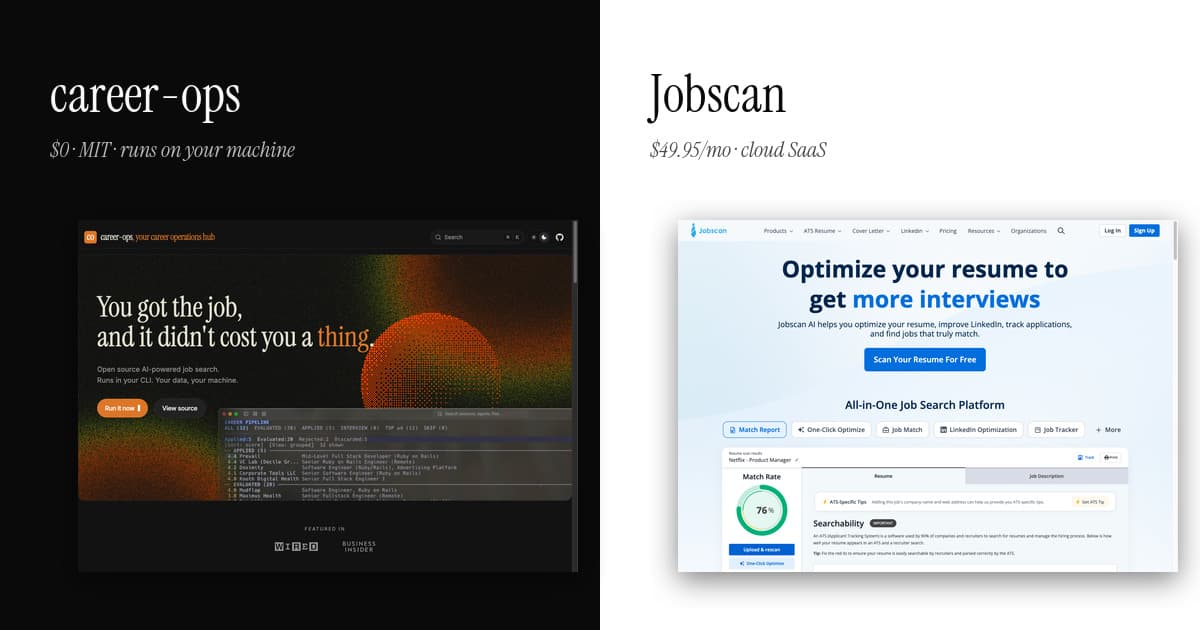
career-ops is a free, MIT-licensed job search pipeline that runs locally inside your AI coding CLI — it scans portals, scores listings, tailors your CV and tracks applications. Jobscan is a paid web tool that checks one resume against one job description for ATS keywords. Use Jobscan for spot-checks; use career-ops to run the entire search.
Jobscan is a polished ATS scanner with a low setup bar. career-ops is an end-to-end pipeline that runs on your machine. Different tools, different audiences. Here is the honest comparison.
The honest summary
Pick career-ops if you write code and want the full pipeline plus pre-apply form drafting. Pick Jobscan if you want a one-click ATS scan and zero setup.
Jobscan does one thing well: tells you which keywords your resume is missing for a specific job description. Their UX is polished, their match score is easy to read, and you are productive in two minutes. The trade-offs are real: $50 a month, your data lives on their servers, and the algorithm is a black box.
career-ops is end-to-end and local-first. Scan portals, evaluate listings against a transparent rubric of five scoring dimensions plus a holistic global score, tailor your CV per job, and — the part nobody else does — pre-apply: the apply mode reads the portal's form, drafts answers for every open-ended question from your profile and the JD, and hands them back for you to review and submit. That single feature saves 15-20 minutes per application, the slowest step in any serious search. The trade-offs are also real: you need Node 22.5+, you run things in a terminal, and the methodology assumes you read documentation. Most non-devs would find that setup painful. Most devs would find Jobscan limiting.
Different audiences, different price points, different philosophies. The pre-apply step is where career-ops materially leaves the rest behind.
Feature matrix
| Feature | career-ops | Jobscan |
|---|---|---|
| ATS keyword matching | Yes — built into the evaluate mode, scored against five scoring dimensions plus a holistic global score | Yes — core product feature with detailed match report |
| Resume tailoring per listing | Yes — automated via the tailor mode, generates a new CV draft per job | Manual — surfaces gaps, you rewrite |
| Job scanning across portals | Yes — scans Greenhouse, Ashby, Lever, Workday, SmartRecruiters | No — single-listing focus |
| Application tracker | Yes — Go TUI dashboard, pipeline stages | Yes — separate product, additional cost |
| Cover letter generation | Yes — tailored per listing via apply mode | Yes — separate tool, included in higher tiers |
| Data ownership | Local-first. Your CV, evaluations, and tracking never leave your machine. | Uploaded to Jobscan cloud. Subject to their privacy policy. |
| Setup | git clone + npm install + config. 10–15 minutes if you already have Node 18+. | Sign up, paste resume. Two minutes. |
| Pre-apply form assistance | Yes — apply mode reads the portal form fields, drafts contextual answers for every open-ended question from your profile + JD, hands them back for you to review and paste. Saves 15-20 minutes per application without ever auto-submitting. | None. Jobscan stops at the resume scan; you fill the application portal manually. |
| Recurring cost | $0 for the tool. AI CLI subscription you already pay for (Claude Pro $20/mo typical). | $49.95/mo monthly or $39.95/mo annual. |
| Source code | Open source, MIT-licensed. github.com/career-ops-hq/career-ops. | Closed. You see the output, not the logic. |
| Methodology transparency | Published rubric (five scoring dimensions plus a holistic global score, A–H evaluation prompt). career-ops.org/methodology. | Algorithm not disclosed. |
| Press / media coverage | Featured in WIRED Greece and Business Insider (US & DE), April 2026. 44K+ GitHub stars. | Established 2013. Industry-trade press coverage over the years (jobscan.co/press). |
Pricing & license at a glance
career-ops
$0 (MIT, open source)
Recurring cost: only your AI CLI subscription (Claude Pro $20/mo typical). Your data never leaves your machine.
Jobscan
$49.95/mo (or $39.95/mo annual). Free tier: 2 scans/month.
Proprietary, closed-source. Cloud SaaS. Resume and job description uploaded to Jobscan servers.
Frequently asked
- Can career-ops replace Jobscan for ATS scoring?
- For technical users, yes. The evaluate mode scores any listing against a rubric of five scoring dimensions plus a holistic global score, that includes ATS-relevant signals — keyword density, role alignment, seniority match. It also gives you the tailor mode and apply mode that Jobscan does not. For non-technical users who want a polished GUI, Jobscan is still the easier tool.
- Is career-ops really free?
- The software is MIT-licensed and costs zero. The actual recurring cost is whatever AI CLI you already pay for — most users run it on Claude Pro at $20/month, which covers all the evaluations, tailoring, and applications they will run in a typical job search.
- What happens to my resume data with career-ops?
- Nothing. Your CV, your evaluation history, your tracked applications — all of it stays on your machine. There is no career-ops cloud, no account, no telemetry. The only network traffic is what your AI CLI of choice generates when you invoke it.
- Why is career-ops harder to set up than Jobscan?
- It is a command-line tool, not a SaaS product. You git clone the repo, run npm install, configure a profile YAML, and invoke modes through your AI CLI. That setup buys you data ownership, transparent methodology, and a tool that does scan + evaluate + tailor + apply + track — things Jobscan splits across multiple paid products.
See all comparisons at /compare. Read about the project at /about. The numbers behind the approach: 740 listings, analyzed.