By Santiago Fernández de Valderrama Aparicio, Applied AI Operator · Last updated
career-ops vs LazyApply
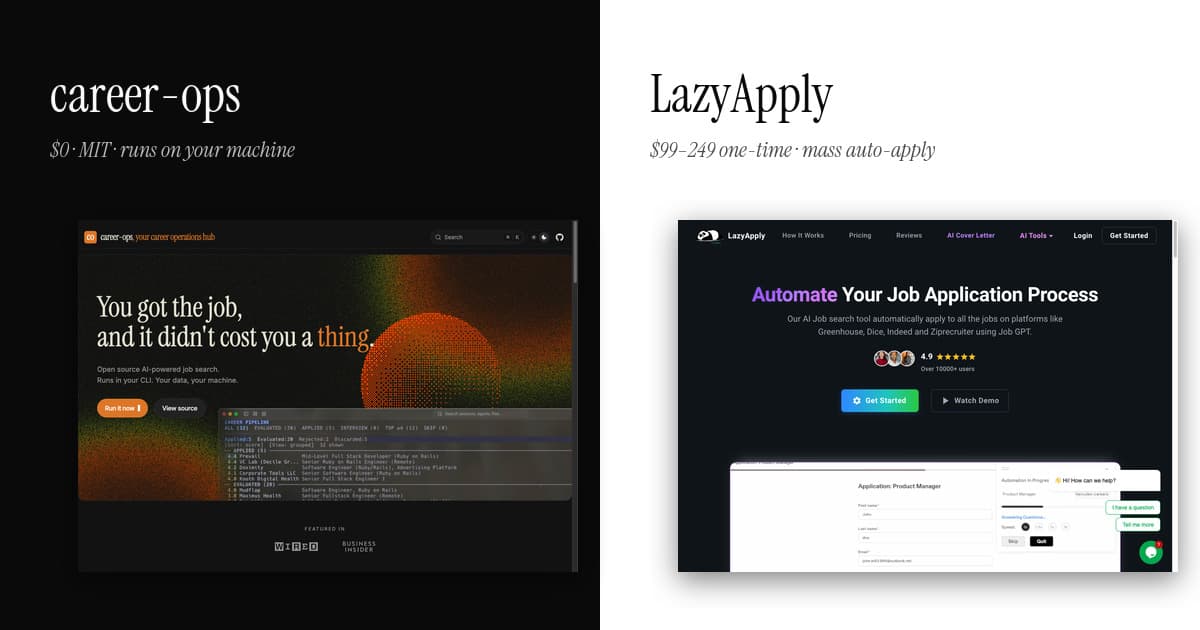
LazyApply clicks Easy Apply buttons for you — hundreds of near-identical applications per day. career-ops explicitly rejects that model: it never auto-submits. It scores each listing against your profile first, tailors a CV for the ones worth pursuing, and leaves the final click to you. Volume automation versus decision automation is the entire difference.
LazyApply is the explicit auto-apply tool — it physically clicks Easy Apply buttons on LinkedIn and Indeed for you, hundreds of times per day. career-ops is the opposite posture: filter aggressively, tailor every application, draft each portal form, and the candidate clicks submit. Two philosophies, very different outcomes.
The honest summary
Pick career-ops if you want fewer, better applications that recruiters take seriously. Pick LazyApply if you treat applications as a numbers game and accept the trade-offs.
LazyApply is honest about what it is. The marketing says spray-and-pray, the product delivers spray-and-pray, and the price ($99–$249 one-time) is reasonable for what it does. For candidates who have already given up on tailoring and just want to maximize the surface area of their search, it works as advertised.
The trade-offs are severe and increasingly priced in. LinkedIn and Indeed have caught up — Trustpilot ratings around 2.1 reflect the bot detection wave that landed in 2025-2026. Profile shadowbans and account suspensions are common in user forums. Worse, the response rate on mass auto-applied roles is dramatically lower than on tailored applications, because recruiters reading 300 applications per day rejected the LazyApply pattern long ago. You can technically apply to 5,000 jobs in a month with the Ultimate tier; the count of those 5,000 that turn into interviews is rounding-error low.
career-ops is the structural inverse. The scoring rubric rejects roughly 90% of scanned listings before tailoring, so applications go out to the 8-12% that fit. Every application is tailored, including the pre-apply drafting of open-ended portal answers — the part that takes 15-20 minutes that most candidates skip. The result: fewer applications, dramatically higher response rate, and zero risk of being shadowbanned by a platform you depend on. If your goal is to land the role, not to hit the application count, the math is one-sided.
Feature matrix
| Feature | career-ops | LazyApply |
|---|---|---|
| Application model | Score-gated apply. Listings scored 1-5 against a rubric of five scoring dimensions plus a holistic global score; only those above 4.0 are recommended. Tailored per listing. You submit. | Spray-and-pray. The bot clicks Easy Apply on every listing matching a keyword filter, hundreds per day. Generic submissions, no tailoring depth. |
| Pre-apply form assistance | Yes — apply mode reads each portal form and drafts contextual answers for every open-ended question from your profile + JD. You review, paste, submit. Saves 15-20 minutes per application without auto-submission. | Auto-submits without drafting open-ended answers. Common failure modes: bot submits to senior roles for entry-level candidates, applies to roles in wrong locations, misses required custom fields. |
| ATS detection risk | None. Applications go through your browser, manually, like any other candidate. | High. LinkedIn and Indeed have cracked down on Easy Apply automation in 2025-2026. Reports of profile shadowbans and account suspensions are common in user forums. |
| Recruiter pipeline impact | Filters down to high-fit listings, sends tailored applications. Recruiters get fewer, better-matched applications. | Submits volume regardless of fit. Cited industry-wide as a driver of recruiter pipeline degradation since 2023. |
| Submission volume per day | Typically 3-8 high-fit applications per day during an active search. Bounded by tailored quality. | 150-300+ per day depending on tier. Volume is the explicit product. |
| Application tracking | Go TUI dashboard with explicit pipeline stages and per-application reports. | Dashboard of bot activity. Less useful for tracking actual conversations because most applications go nowhere. |
| User-reported reliability | Stable. The system runs locally; failures are visible and debuggable. | Trustpilot rating around 2.1 in 2026. Common complaints: applying to wrong roles, refund disputes, bot detection by LinkedIn. |
| Data ownership | Local-first. CV, evaluations, tracking on your machine. | Cloud-hosted plus active browser session control via the extension. |
| Recurring cost | $0 for the tool. Claude Pro $20/mo typical for the AI side. | Lifetime $99–$249 one-time. No monthly plans. |
| Source code | Open source, MIT-licensed. | Closed. |
| Ethical stance | Explicitly cooperative — filter, tailor, retain commit decision. Reject auto-submission (Discussion #274). The candidate's response to the recruiter pipeline arms race should not make the arms race worse. | Explicitly volume-driven. The bot is the product. |
Pricing & license at a glance
career-ops
$0 (MIT, open source)
Recurring cost: only your AI CLI subscription (Claude Pro $20/mo typical). Your data never leaves your machine.
LazyApply
Lifetime plans only — Basic $99 (150 apps/day), Premium $129–$149 (300 apps/day), Ultimate $249 (unlimited).
Proprietary, closed-source. Browser extension that hijacks your active session. Resume and profile stored cloud-side.
Frequently asked
- Why does career-ops refuse to auto-submit when LazyApply does?
- Auto-submission at scale degrades the recruiter pipeline for everyone, including career-ops users. Recruiters drowning in mass auto-applications filter more aggressively, response rates drop industry-wide, and the candidates who actually fit get lost in the noise. The career-ops maintainer rejected the auto-submit pattern in Discussion #274 for exactly this reason. The career-ops apply mode drafts everything — including the open-ended portal questions LazyApply ignores — but leaves the submit button to you.
- Is mass auto-apply actually effective in 2026?
- The data says no. LinkedIn and Indeed have rolled out bot-detection that shadowbans extension users; reports are common in r/cscareerquestions. Response rates on auto-submitted Easy Apply applications are dramatically below tailored applications. Trustpilot rating for LazyApply around 2.1 in 2026 reflects the reality. The model worked in 2022 when platforms were not enforcing aggressively and recruiters were less saturated. It does not work now.
- Can career-ops apply to 100+ jobs in a day like LazyApply?
- Technically possible with batch mode and parallel workers, but the design pushes against it. The scoring rubric is designed to reject most listings before tailoring; an honest daily output is closer to 5-15 high-fit applications. The candidate's leverage in 2026 is filter quality, not volume.
- What is the actual difference in outcome?
- Real numbers from the maintainer's own search in early 2026 using career-ops: 740 listings evaluated, 68 applications submitted (all tailored, all with pre-apply drafting), one offer accepted (a Head of Applied AI role). LazyApply at the Ultimate tier could have submitted 4,500+ applications in the same period with comparable outcomes for senior roles. The funnel shape is opposite.
See all comparisons at /compare. Read about the project at /about. The numbers behind the approach: 740 listings, analyzed.