By Santiago Fernández de Valderrama Aparicio, Applied AI Operator · Last updated
career-ops vs Loopcv
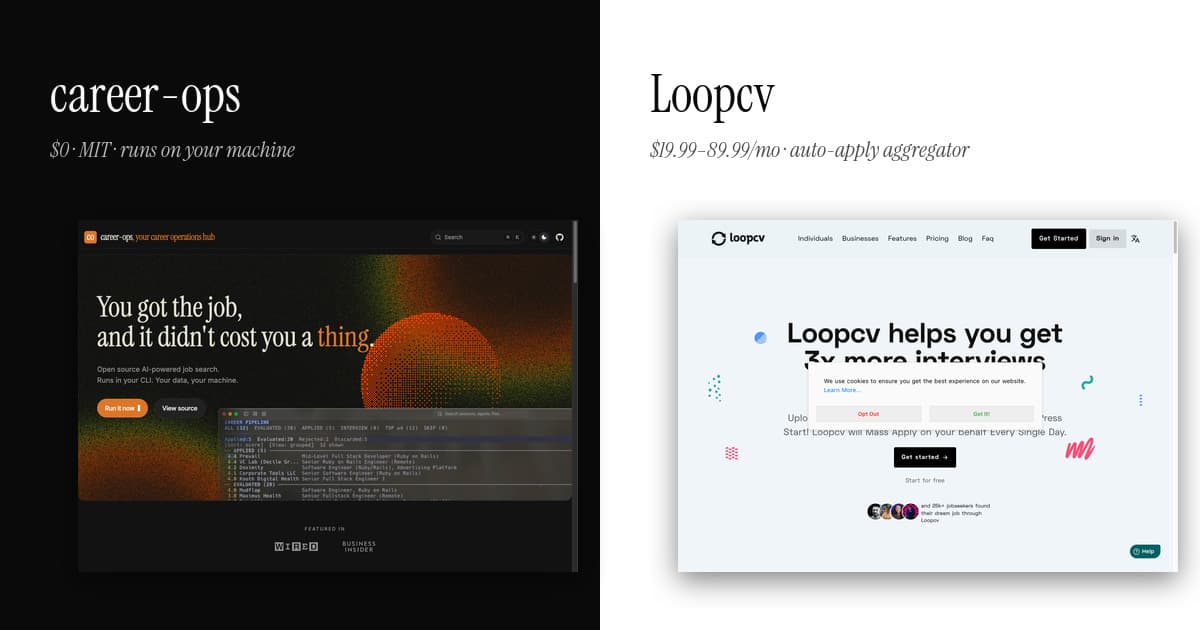
Loopcv is the more disciplined auto-apply service: transparent volume caps, cleaner targeting, still submitting on your behalf from its servers. career-ops never submits for you — it automates the judgment work instead (scanning portals, scoring fit across five dimensions plus a holistic global score, tailoring CVs locally) and keeps you as the only one who ever clicks send.
Loopcv is the cleaner auto-apply player — fewer hallucinated wrong-role submissions than LazyApply, transparent volume caps, a real free tier. career-ops is the opposite philosophy: filter hard, tailor every application, draft each form, and the candidate submits. Both have audiences; the trade-offs are sharp.
The honest summary
Pick career-ops if you want depth — fewer applications, each tailored, each pre-drafted. Pick Loopcv if you want breadth and accept the response-rate trade-off.
Loopcv is the most reasonable tool in the auto-apply category. The free tier (10 applications/month) is genuinely useful for testing, the volume caps are transparent, and the matching is meaningfully better than LazyApply's bot-clicking model. For job seekers who want surface-area coverage and accept the lower per-application response rate, it works.
career-ops takes the opposite posture by design. The scoring rubric is built to reject ~90% of scanned listings before tailoring even begins, so applications go out only to the 8-12% that fit the candidate's archetype. Every application is tailored. The pre-apply step drafts the open-ended portal answers — the part Loopcv's auto-submission either skips or fills with generic content. That 15-20 minutes per application is where applications stop looking generic, and where response rates start to differ.
Concretely: in a 90-day active search, Loopcv at Premium ($59.99/mo) submits ~900 applications. career-ops at the equivalent intensity submits ~60-80 applications, all tailored, all pre-drafted. The interview-conversion ratio on the second pattern is multiples of the first. If your goal is the role, not the count, the math favors career-ops. If you genuinely want to maximize coverage and respond to interest in bulk, Loopcv is the right tool.
Feature matrix
| Feature | career-ops | Loopcv |
|---|---|---|
| Application model | Score-gated apply against the scoring rubric. ~9% threshold pass rate in real searches. | Auto-apply against configurable loops (location, keywords, salary). 100-300 applications/month depending on tier. |
| Pre-apply form assistance | Yes — apply mode drafts contextual answers for every open-ended portal question from your profile + JD. You review, paste, submit. The 15-20 minute time-sink, collapsed. | Auto-submits with generic content for open-ended questions, or skips listings where the form is too custom. No human-in-the-loop review. |
| Submission posture | You submit, every time. Drafted content waits for your review. | Auto-submits by default. The Done-For-You tier adds human advisory but still automates submission. |
| Job board coverage | Greenhouse, Ashby, Lever via public APIs (zero-token). 100+ pre-configured company portals shipping in the repo templates. | 20+ job boards aggregated centrally. Broader surface area but mostly LinkedIn/Indeed-style listings. |
| Email outreach automation | contacto mode drafts outreach messages for review; the candidate sends them manually. | Yes — cold emails recruiters on your behalf, automated. |
| Application volume per month | Typically 60-100 high-fit, tailored applications across an active 90-day search. | Capped per tier — 10 free, 100 Standard, 300 Premium. |
| Response-rate philosophy | Higher per-application response rate via tailoring + pre-apply drafting. | Lower per-application response rate, offset by volume. Effective applications/interview ratio is the relevant metric, and it favors the tailored approach in 2026 data. |
| Setup time | 10-15 minutes if you already have Node 18+. | Five minutes — upload CV, configure loops, done. |
| Recurring cost | $0 for the tool. Claude Pro $20/mo typical. | Free 10 apps/month, then $19.99–$89.99/mo for meaningful volume. |
| Data ownership | Local-first. Profile and history on your machine. | Cloud-hosted. Profile, CV, and applications on Loopcv servers. |
| Source code | Open source, MIT-licensed. | Closed. |
Pricing & license at a glance
career-ops
$0 (MIT, open source)
Recurring cost: only your AI CLI subscription (Claude Pro $20/mo typical). Your data never leaves your machine.
Loopcv
Free tier (10 apps/month). Standard $19.99/mo (100 apps), Premium $59.99/mo (300 apps), Done-For-You $89.99/mo (adds human advisory).
Proprietary, closed-source. Cloud SaaS. Profile, CV, and tracking data on Loopcv servers.
Frequently asked
- Does career-ops have an auto-apply mode like Loopcv?
- No, and one is not planned. The apply mode drafts the application content and surfaces it for your review, but the candidate submits manually. The maintainer rejected auto-submission in Discussion #274 because mass auto-apply at scale degrades the recruiter pipeline for everyone, including career-ops users.
- Can I integrate Loopcv with career-ops?
- Not directly, and the philosophies clash. Loopcv assumes high-volume auto-submission; career-ops assumes low-volume tailored submission with human review. You could use both in parallel — career-ops for top-tier applications you take seriously, Loopcv for breadth coverage of less-targeted roles — but the workflows do not share data.
- What is career-ops's response-rate evidence?
- The maintainer's own search in early 2026 used career-ops end-to-end: 740 listings evaluated, 68 applications submitted (~9% threshold pass), one offer accepted (Head of Applied AI). The per-application response rate on tailored + pre-drafted applications was multiples of the historical baseline for untailored mass applications in the same job market.
- Why does the pre-apply step matter so much?
- Most portal application forms have 3-5 open-ended questions per role (why this company, why this role, tell us about a relevant project, salary expectations). These are the 15-20 minutes per application where most candidates default to copy-paste templates that recruiters can spot in two seconds. career-ops's apply mode reads the JD and the candidate profile and drafts each answer to the specific role. The candidate reviews and pastes. That is the unlock.
See all comparisons at /compare. Read about the project at /about. The numbers behind the approach: 740 listings, analyzed.